



Chronicles of Cork: Marcel Opens an 1863 Offley Port with a Feather
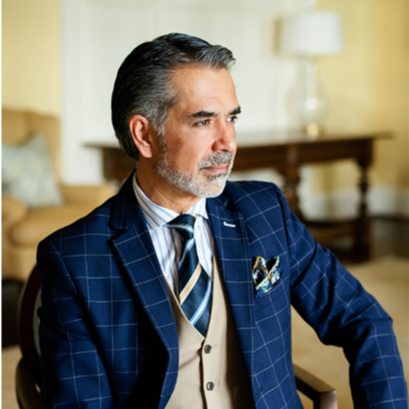
Marcel Bregstein Chevalier, CCM/Sommelier
Assistant General Manager, Toronto Hunt Club
An 1863 Offley Vintage Port is more than just an old bottle of wine—it is a piece of history.
Produced before Canadian Confederation, this extraordinary Port came from one of the greatest harvests ever recorded in Portugal's Douro Valley. The 1863 vintage is widely regarded as one of the finest of the nineteenth century, produced just before the devastating phylloxera epidemic forever changed European vineyards.
Bottles from this vintage are museum-quality treasures, rarely seen outside prestigious private collections, exclusive tastings or specialized auctions.
The pre-Phylloxera bottle was brought from Portugal to honour the legendary Peter Mielzynski at the PMA Chairman's Gala. Some estimated its value at more than $20,000.
In many ways, it was the hospitality industry's version of the Met Gala.
Wine and spirit producers represented by PMA travelled from around the world to showcase their finest products. More than 500 guests wandered through elaborate tasting stations while enjoying lavish food displays created by some of the best culinary talent in the country.
Each gala featured a special surprise arranged by my friend Todd McDonald, Director of Fine Wines & Spirits.
For this Gala, Todd announced that he had secured an 1863 Offley Vintage Port to celebrate the Chairman.
I immediately suggested something unusual.
“I've opened old Ports using traditional Port tongs,” I told him. “Why don't we open this one with a feather?”
Todd loved the idea.
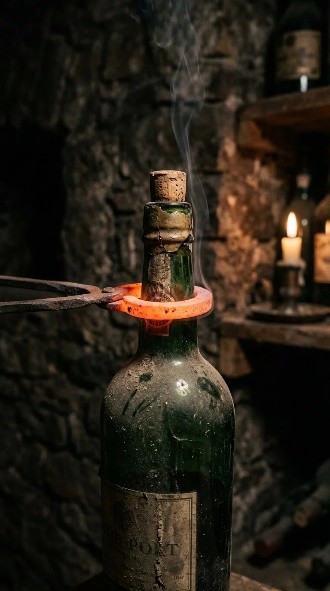
Port tongs are specially designed metal tools used to open extremely old bottles whose corks have become too fragile for a corkscrew.
The tongs are heated until they glow red-hot and are clamped around the neck of the bottle just below the cork. After about a minute, a cold cloth—or another cold object—is applied to the heated glass.
The dramatic change in temperature creates a perfectly clean thermal fracture, allowing the entire top of the bottle, cork included, to lift away without disturbing the wine.
For this ceremony, however, I decided to replace the traditional cold cloth with something far more dramatic: a Scarlet Macaw feather.
We borrowed the feather from the Metro Toronto Zoo as a tribute to Costa Rica, my country of birth.
At the time, it seemed like a great idea.
The Day of the Gala
Nearly thirty members of the media filled the Hunt Dining Room overlooking Lake Ontario.
Among them were Tony Aspler, David Lawrason, reporters from the Toronto Star, Global Television and many of Canada's most respected wine writers.
Everything was staged like a theatrical performance.
As the ceremony began, the President of the Port Association handed me his personal set of historic Port tongs. I then handed them to Edouard, who disappeared into the kitchen to heat them until they glowed red.
Just before he walked away, the President quietly leaned over and whispered something that nearly stopped my heart.
“You know...there's a chance this bottle could explode. It's hand-blown glass.”
Suddenly, everything changed.
If the bottle exploded, no one would taste the Port. I would ruin a priceless bottle worth more than $20,000—in front of Canada's wine media.
My career could be over before it truly began.
Moments later, the Scarlet Macaw feather was ceremoniously carried down the aisle and placed into my hands. I carefully submerged it into a bucket filled with ice water while one of Offley's principals began explaining the history and significance of the bottle.
As he spoke, I wasn't listening.
I was wondering whether I should abandon the entire idea.
As he finished his presentation, I gave Edouard the signal to get the tongs.
I clamped the tongs around the bottle. I could not feel the vibration of the heat going through the glass. I was praying in my head and asking that the bottle not blow up.
Thankfully, the bottle did not explode.
But it wasn't hot enough to open it with the feather.
The tongs had to go back to be heated once again.
It took about ten minutes—the most uncomfortable ten minutes, because there was nothing left to say about the Port. Everything had already been covered during the presentation.
The audience simply stared at me.
It was the longest ten minutes of my life.
Edouard returned with the glowing tongs. I clamped them around the bottle and could feel the vibration of the heat moving through the glass.
Sweat poured down my forehead as thirty journalists sat in complete silence waiting for something—anything—to happen.
Ironically, that made me even more nervous.
Now I was convinced the bottle really might explode.
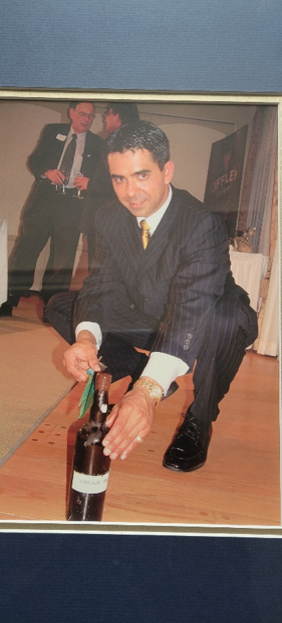
For nearly ninety seconds, I slowly rotated the bottle, making sure the heat was distributed evenly around the neck. Then I carefully removed the tongs and handed them back.
Everything now depended on the feather.
I reached into the bucket.
The feather was ice cold.
The room was silent.
Every face in the audience reflected exactly what I was feeling.
Fear!
Would the bottle shatter? Or would it separate perfectly?
I gently touched the cold feather against the heated glass.
Crack.
The neck separated with a flawless, razor-clean cut.
For a split second, no one moved.
Then the room erupted.
People leapt to their feet cheering. It felt as though Canada had just scored the winning goal in Olympic hockey against the United States.
Months of planning had come down to one perfect moment.
.png)
Tasting History
The Port was carefully decanted and poured into specially commissioned crystal glasses created exclusively for the event.
Suddenly, the media's attention shifted from the bottle to me.
Reporters surrounded me with questions while I stared at the half glass of Port in my hand.
I remember thinking, “I'm holding about $2,000 worth of wine.”
And then I tasted it.
It was remarkably smooth, displaying beautiful notes of dried fruit, toasted nuts, caramel and remarkable sweetness.
Even after more than 140 years, it remained wonderfully alive.
But these ancient wines are fragile.
By my third sip, exposure to oxygen had rapidly stripped away much of its character. The magic had disappeared almost as quickly as it had arrived.
It was a fleeting experience.
One that can never be repeated.
The Bottle That Disappeared
People often ask me whether I kept the bottle.
Unfortunately, I didn't.
Only minutes after the Port had been decanted, the empty bottle disappeared. To this day, I have no idea where it went.
But while the bottle may be gone, the memory remains one of the greatest moments of my career—a day when history, theatre and wine came together in front of a room full of witnesses, all because of a pair of glowing Port tongs...and a single Scarlet Macaw feather.
You can watch the Global News segment from the event here: https://www.youtube.com/watch?v=ts6YUKmu6sY
Port wine can age much longer than regular table wine because of its higher alcohol content, residual sugar and rich tannins, which all contribute to its remarkable longevity.
During fermentation, grape brandy is added, raising the alcohol level to around 20% and stopping fermentation. This leaves natural residual sugar in the wine while the higher alcohol helps protect it from spoilage.
The grapes used for Port, particularly those grown in Portugal's Douro Valley, also provide significant structure, colour and tannins that contribute to the wine's ability to develop over many decades.
The result is a wine uniquely capable of defying time.
That longevity is part of what makes opening an ancient Port such a special experience. You're not simply tasting an old wine. You're tasting something that has survived generations, changes in winemaking, changes in the vineyard and changes in the world around it.
And sometimes, if you're lucky, you get to be the person holding the feather.

Contact Info
 | 1401-2045 Lake Shore Blvd. W. Toronto, ON M8V 2Z6 |
 | (416) 878-6066 |
 | admin@cmacontario.com |
About Us
The Ontario Branch of the CMAC has more than 80 clubs, mostly private golf, yacht, athletic and city clubs located in central and southern Ontario between Brantford on the West and Belleville on the East. At over 250 members, it is the largest Branch in CMAC and offers tremendous value for members through professional development, excellent opportunities for networking, promotion of club management as a career, and support through scholarships and donations.
Follow Us!


© Club Management Association of Canada - Ontario Branch. All rights reserved.